
Choosing the best location to open a dental clinic is one of the most important decisions for dentists planning to start a practice in India. A good location can improve patient accessibility, treatment acceptance and long-term profitability, while a poor choice can lead to high expenses and slow patient growth. Conducting a proper dental clinic market analysis before signing a lease helps you evaluate local demand, competition, affordability and financial feasibility.
Why Location and Market Feasibility Make or Break a Dental Clinic
A premium commercial property does not automatically guarantee more dental patients. Your clinic needs to be accessible, affordable for the local population and positioned to meet actual healthcare needs.
Understanding Local Market Opportunities
Tier-1 cities may offer higher treatment fees but also have substantial competition and rental expenses. Tier-2 cities, suburban neighbourhoods and developing residential areas may offer opportunities where patient demand, competition and operating costs are more favourable.
Do not judge an area only by the number of dentists. Assess existing patient demand, household spending capacity, accessibility and the services competitors provide.
How to Conduct a Dental Clinic Market Analysis Before Signing a Lease
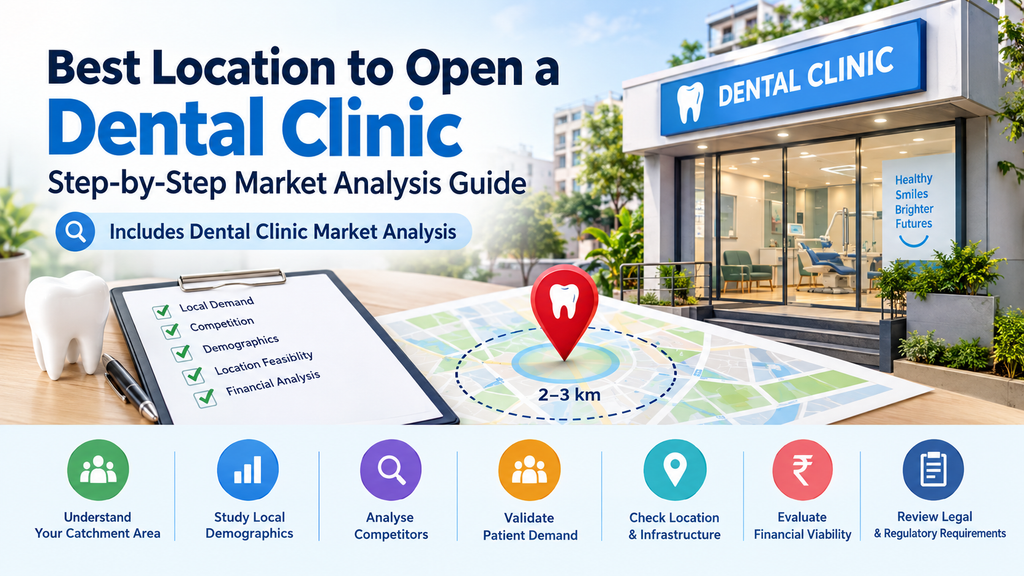
Step 1: Define Your 2–3 Kilometre Catchment Area
Start by studying the neighbourhood within approximately 2–3 kilometres of your proposed clinic. Nearby residents may become regular patients because travelling for routine dental care is inconvenient.
Consider two groups:
- Primary catchment: Residents who can reach your clinic within approximately 5–10 minutes.
- Secondary catchment: Patients willing to travel 10–15 minutes or longer for convenient appointments, specialist services or trusted treatment.
These distances are starting points, not fixed rules. Railway crossings, highways, traffic congestion and flyovers can significantly affect travel time.
Step 2: Analyse Local Demographics and Spending Capacity
Study the area’s residential population, occupations, household income and access to healthcare. Check whether the neighbourhood contains families, working professionals, students, elderly residents or a growing population.
Match your proposed services to local needs. For example:
- Family dentistry and preventive care for residential neighbourhoods.
- Restorative treatments and root canal treatment for general dental patients.
- Orthodontics and aligners where there is sufficient demand and affordability.
- Implants and advanced procedures where the local market can support these services.
Market research involves collecting and analysing information to make better business decisions. You can explore the concept in this market research guide.
Step 3: Conduct a Ground-Level Competitor Audit
Use Google Maps and Google Business Profiles to identify nearby dental clinics. Review their ratings, patient feedback, opening hours, services and online visibility.
Visit the area and compare clinics where possible. Look for opportunities such as:
- Limited evening or Sunday appointments.
- Few clinics offering particular specialist services.
- Poor accessibility or inconvenient appointment arrangements.
- Patient complaints about communication or waiting times.
- Demand for transparent treatment explanations and flexible payment options.
Avoid starting a price war simply because another dentist charges less. A better patient experience, convenient appointments and clear communication can help differentiate your practice.
Step 4: Validate Actual Patient Demand
High footfall does not necessarily mean high dental patient demand. Before investing, visit the proposed location on weekdays and weekends, at different times of day.
Speak with local residents, nearby pharmacies and healthcare providers. Observe residential societies, offices, schools, markets and public transport connections.
Ask whether residents currently travel elsewhere for dental treatment and what inconveniences they experience. These conversations can reveal opportunities that online research alone may miss.
Step 5: Identify Underserved Neighbourhoods
Compare several locations instead of selecting the first available property. Look for emerging residential areas, growing communities or neighbourhoods where existing clinics may not adequately serve local needs.
The objective is not necessarily to find an area without dentists. It is to find a location where sufficient patient demand exists and your clinic can offer a sustainable, differentiated service.
Choosing the Best Location to Open a Dental Clinic: Site Evaluation Criteria
Visibility, Accessibility and Footfall
Ground-floor, high-street premises can offer better visibility, but they may have higher rent. A first-floor clinic may also succeed if it has clear signage, convenient stairs or lift access and a strong local reputation.
Evaluate:
- Visibility from the main road and permission for signage.
- Two-wheeler and car parking or convenient patient drop-off.
- Public transport access and safe entry.
- Accessibility for elderly patients and people with disabilities.
- Nearby landmarks that help patients locate the clinic.
Space Planning and Technical Infrastructure
Check whether the premises can accommodate your reception, waiting area, dental chair, treatment room, sterilisation zone and storage requirements. Consider future expansion if you plan to add another chair.
Before signing the lease, verify:
- Adequate electricity, earthing and electrical load.
- Water supply, plumbing and drainage.
- Ventilation, air conditioning and compressor placement.
- Space and applicable radiation-protection requirements for dental X-ray equipment.
Review this dental clinic floor plan and layout guide before finalising your premises. For X-ray installations, consult the Atomic Energy Regulatory Board (AERB) for applicable requirements.
Financial Due Diligence: Rent, Revenue and Lease Negotiation
Calculate the Total Occupancy Cost
Do not compare locations using rent alone. Include the security deposit, brokerage, advance rent, renovation, plumbing, electrical work, equipment installation, maintenance charges, electricity and applicable property-related taxes.
Estimate monthly collections using realistic patient numbers and treatment fees. Then compare the expected revenue with rent, salaries, consumables, equipment maintenance, electricity and other operating expenses.
A high-rent location can put considerable pressure on a new clinic before patient flow becomes stable.
Review the Rental Agreement
Before signing, review the lease duration, lock-in period, renewal conditions, rent escalation, exit clauses and permission for clinical use and signage. Obtain written consent for necessary alterations and equipment installation.
Confirm that the property can legally be used for your intended practice and that any required building or local permissions can be obtained.
Calculate Whether Your Selected Location Can Support a Profitable Clinic
Estimate Your Break-Even Point
A promising market is not enough if the clinic cannot cover its expenses. Estimate expected monthly patients, average collection per patient and monthly operating costs.
For example, suppose your clinic has monthly fixed costs of ₹80,000 and a contribution margin of 60%.
Break-even monthly revenue = Fixed costs ÷ Contribution margin ratio
₹80,000 ÷ 0.60 = approximately ₹1,33,333 per month.
This is an illustrative example, not an industry benchmark. Your actual break-even point will depend on rent, staffing, consumables, treatment mix and other expenses.
Also prepare conservative, moderate and optimistic patient-flow scenarios. Keep a reserve for slow initial growth and unexpected expenses, and distinguish operating break-even from recovering your initial setup investment.
Read the detailed guide on dental clinic monthly expenses and break-even analysis.
Seven-Point Location Feasibility Scorecard for Indian Dentists
Score each shortlisted property from 1 to 10 based on evidence. Use the table to compare three or more locations before making your decision.
| Evaluation factor | Positive indicator |
|---|---|
| Local demand and competition | Sufficient demand and a viable competitive position |
| Visibility | Easy to find with clear signage |
| Floor placement | Convenient entry and accessibility |
| Parking and transport | Practical access for intended patients |
| Technical infrastructure | Suitable power, water and drainage |
| Lease conditions | Clear permissions and reasonable exit terms |
| Financial feasibility | Affordable setup and operating costs |
Add the seven scores to obtain a total out of 70. A higher score can help identify a promising property, but it does not replace legal, technical and financial checks. Serious problems with property permissions, radiation safety or affordability should not be ignored simply because the total score is high.
Legal and Regulatory Checks Before Finalising a Dental Clinic Location
Requirements can vary by state, municipality, property type and clinical services. Before committing to a property, verify permitted use, applicable municipal and clinical establishment requirements, biomedical waste management arrangements, fire safety and signage requirements where applicable.
Check the official Clinical Establishments portal and confirm which rules apply to your state and practice.
You can also read this guide on making your dental clinic ABDM-compliant.
Common Location Selection Mistakes Dentists Must Avoid
Avoid these common mistakes when choosing a clinic location:
- Selecting a property solely because the rent is low.
- Assuming a busy road guarantees dental patients.
- Ignoring competitor services and local spending capacity.
- Signing a lease before checking permissions.
- Underestimating renovation and equipment installation costs.
- Spending the entire budget without keeping a reserve fund.
- Ignoring future expansion and the risk of relocation.
Planning a New Clinic? Get Dental Clinic Setup Cost Guidance & Site Feasibility Auditing
Underestimating setup expenses or choosing the wrong catchment can delay break-even by over 12 months. Work 1-on-1 with an experienced Dental Clinic Setup Consultant to get clear equipment budgeting, chair layout planning, location footfall validation, and commercial lease review.
- Setup Cost Guidance: Accurate CAPEX, OPEX & equipment budgeting
- Site & Footfall Feasibility: Catchment demographics & competitor audits
- Faster Break-Even: Avoid expensive lease traps & chair design errors
An Experienced Dentist’s Advice Before Finalising Your Clinic Location
As a practising dentist and owner of two dental clinics, my advice is to evaluate the location as carefully as you evaluate your clinical equipment.
- Prefer your own premises if financially feasible. If you rent initially, consider whether you can eventually purchase property in the same locality.
- Understand relocation risks. A landlord may not renew your lease, potentially forcing you to rebuild your patient base elsewhere.
- Keep sufficient reserve funds. Do not spend your entire budget on interiors and equipment before opening.
- Check Rainwater Drainage: Before finalising the property, check whether rainwater stagnates during the monsoon and whether the surrounding area drains properly. Waterlogging can inconvenience patients, affect accessibility and potentially damage clinic interiors and equipment.
- Prioritise sustainable demand. A convenient, affordable location with genuine patient demand may be more valuable than a prestigious address with excessive rent.
For more practical guidance, read how to start a dental clinic in India.
Conclusion: Choose a Dental Clinic Location Based on Evidence
Finding the best location to open a dental clinic requires more than choosing a busy road or an attractive property. Conduct a dental clinic market analysis, evaluate competition and patient demand, verify infrastructure and permissions, calculate financial feasibility and compare shortlisted properties before signing a lease.
Frequently Asked Questions About Choosing a Dental Clinic Location
Practical, ground-level answers to critical questions about site selection, catchment demand, rent ratios, and commercial lease terms.
What Is the Best Location to Open a Dental Clinic in India?
The best location is one that balances strong local patient demand, sustainable rental overhead, seamless accessibility, dependable commercial infrastructure, and a realistic market gap to compete. Rather than choosing an expensive prime commercial high street solely for vanity, prioritize an area with a healthy dentist-to-population ratio (ideally 1:7,500 or higher in suburban belts) where your intended clinical treatments match local household spending power.
How Do I Conduct Market Research Before Opening a Dental Clinic?
A reliable market analysis involves five practical steps: mapping all established clinics within a 2–3 km catchment on Google Maps, studying residential demographics (age distribution and disposable income), auditing competitors’ consultation fees and working hours, conducting ground visits during peak morning and evening intervals, and calculating your estimated chair break-even revenue against fixed monthly overheads.
How Many Dental Clinics Should Be in a 2–3 Kilometre Radius?
There is no single universal ceiling for clinic density. Instead of counting raw competitor numbers, calculate the ratio of local residents to active chairs. A micro-market with 6 existing clinics can easily support a new practice if the residential catchment exceeds 40,000 people and existing clinics lack modern diagnostic tools, weekend evening appointments, or specialized pediatric and aligner treatments.
Is a Ground-Floor Dental Clinic Better Than a First-Floor Clinic?
Ground-floor clinics provide superior incidental footfall, effortless street visibility, and barrier-free access for elderly or mobility-impaired patients. However, a first-floor clinic is often 30% to 50% cheaper in monthly rent. A first-floor space works very well provided the building has a dependable elevator, prominent exterior signage rights visible from the main road, and wide, well-lit staircases.
What Percentage of Revenue Should Be Spent on Dental Clinic Rent?
As a standard dental practice benchmark, commercial rent should ideally stay within 8% to 12% of your projected gross monthly collections (and should never exceed 15% during early phases). Keeping rent conservative ensures that sufficient operating capital remains for staff salaries, dental lab charges, consumables, utility bills, and loan repayments during slower operational cycles.
How Can I Estimate Patient Demand Before Opening a Dental Clinic?
Estimate demand using an evidence-based approach rather than relying solely on passing foot traffic. Audit local residential societies, consult neighboring general physicians and diagnostic labs regarding referral flow, review negative feedback trends on competing clinics’ Google profiles to uncover unmet expectations, and build realistic financial scenarios based on serving 3 to 5 new patients daily during your first quarter.
How Much Reserve Money Should I Keep After Setting Up a Dental Clinic?
Keep an emergency operating reserve equivalent to at least 6 to 9 months of fixed operational expenses (rent, electricity, assistant salary, EMI, and waste management fees). Because a new dental setup typically takes 6 to 12 months to hit cash-flow break-even, maintaining this safety fund prevents severe liquidity stress before chair occupancy normalizes.
What Should I Check Before Signing a Dental Clinic Rental Agreement?
Verify that the commercial title allows clinical activity, obtain explicit landlord consent for core plumbing cutting and suction lines, negotiate a minimum 5-to-9 year tenure with an initial 3-year lock-in protection, cap rent escalation to 5% annually (or 15% every 3 years), secure exterior facade signage rights, and negotiate a 45–60 day rent-free fit-out period for interior renovations.

Dr. Anuran Ghosh Mondal is a BDS-qualified dentist, private practitioner and dental clinic owner with 12+ years of clinical experience in India. He is the founder of DentalClinicAlly.com and DentistUpgrade.com and has practical experience in Dental Clinic Business Consulting- dental practice management, patient acquisition, market analysis, branding, marketing and clinic growth.