
A successful dental practice does not grow simply by adding more patients. At a certain point, growth depends on how efficiently you use your dental chairs, control overhead, delegate clinical work, improve case acceptance, and create a predictable patient-acquisition system. A practical dental clinic growth strategy connects these areas into one operating model. The goal is to move from a dentist-dependent practice to a system-driven dental business that can grow without continuously increasing the owner’s workload.
Scaling a private dental clinic beyond solo production requires shifting from a purely clinical mindset to a structured business framework. Sustainable expansion depends on five operational pillars: optimizing chair utilization rates, streamlining treatment acceptance workflows, controlling overhead benchmarks, and delegating routine procedures to associate dentists. (If your primary hurdle is an empty appointment book rather than operational capacity, start with our foundational dental practice marketing plan).
If you are planning to scale dental practice operations, start by understanding which stage your clinic is currently in.
Dentist’s Insight: In my experience as a practicing dentist and dental clinic owner, many dentists try to solve every growth problem by increasing marketing. However, if the real bottleneck is chair utilization, treatment acceptance, scheduling, staffing or profitability, generating more patient enquiries may simply increase operational pressure. Before investing more in marketing or expanding the clinic, identify the specific bottleneck that is limiting growth and address that problem first.
The 4 Stages of Dental Practice Growth
Stage 1 – The Solo Practitioner (High Hustle, Variable Cash Flow)
The dentist performs most clinical procedures, manages staff, handles treatment planning, and often makes business decisions personally.
Revenue can be healthy, but growth is limited by the dentist’s available clinical hours.
Stage 2 – The Capacity Bottleneck (80%+ Chair Occupancy & Burnout)
Once the appointment book consistently reaches around 80% or more of available capacity, adding more patients becomes difficult.
The problem is no longer simply marketing. It becomes an operational problem involving scheduling, cancellations, chair availability, staff productivity, and dentist fatigue.
Stage 3 – The Systems & Multi-Chair Era (Associate Dentists & SOPs)
The practice begins using additional operatories, associates, trained staff, standardized workflows, and documented SOPs.
The owner gradually moves from doing everything personally to managing a clinical system.
Stage 4 – The Scalable, High-Equity Dental Enterprise
At this stage, the clinic operates through predictable systems rather than depending entirely on the owner.
Multiple chairs, associates, treatment coordinators, marketing systems, financial controls, and management processes work together to create scalable revenue and stronger business value.
Pillar 1 – Maximizing Chair Utilization and Clinical Capacity
Before investing in another chair, determine whether your existing capacity is being fully utilized.
How to Calculate Your Practice’s True Chair Occupancy Rate
The Formula: Active Treatment Hours vs. Operational Chair Hours
A simple calculation is:
Dental Chair Utilization Rate = Active Treatment Hours ÷ Available Operational Chair Hours × 100
For example, if a chair is operationally available for 40 hours per week but is actively producing for 30 hours:
30 ÷ 40 × 100 = 75% utilization
This helps distinguish a genuine capacity problem from an appointment-booking problem.
Track chair utilization over several weeks or months rather than judging your practice from a single unusually busy or slow week.
Extending Shift Hours vs. Installing an Additional Operatory
If existing chairs have significant unused capacity, extending hours or improving scheduling may be more economical than adding another operatory.
If chairs are consistently busy and demand is strong, an additional operatory may make more sense.
Eliminating Cancellation & Late-Arrival Production Leaks
Use appointment confirmations, waiting lists, cancellation policies, pre-appointment calls, and short-notice filling systems.
Small scheduling improvements can recover substantial annual production without increasing advertising expenditure.
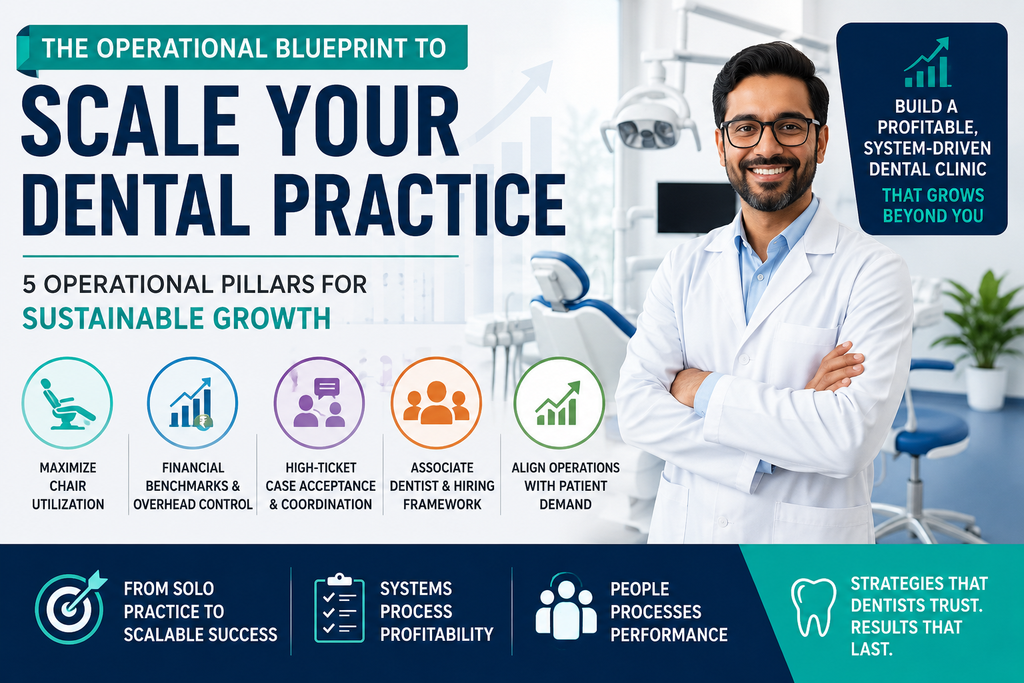
Pillar 2 – Critical Financial Benchmarks & Overhead Control
Revenue alone does not tell you whether a dental clinic is healthy. Owners should monitor expenses and profitability alongside production and collections.
The Core KPIs Every Dental Clinic Owner Must Track
Your dental clinic financial benchmarks should include:
Dental Lab Cost Ratio (Target: 8%–12% of Gross Revenue)
Monitor laboratory expenses against revenue and investigate significant increases.
Auxiliary Staff Payroll (Target: 18%–24% of Gross Revenue)
Staff costs should be reviewed alongside productivity, chair utilization, and patient volume rather than treated as an isolated expense.
Marketing Reinvestment Benchmark (Target: 5%–8% for Established Clinics)
Established clinics can consider reinvesting a portion of revenue into marketing, depending on their growth objectives and local market.
Net Operating Profit Margin (Target: 35%–45% for Solo Practices)
This can be a useful management benchmark, but actual margins vary considerably by location, rent, staffing, treatment mix, doctor compensation, and practice model.
Important: These figures are reference ranges for practice-management planning, not universal standards for every dental clinic. Actual costs and profitability can vary based on location, rent, staffing model, treatment mix, laboratory expenses, doctor compensation, clinic size and stage of growth.
Optimizing Your Treatment Mix: Balancing Maintenance Care with High-Ticket Procedures
A healthy clinic needs a balance between preventive and maintenance dentistry and comprehensive procedures such as implants, aligners, crowns, bridges, and rehabilitation.
The objective is not to push expensive treatment. It is to diagnose appropriately, explain treatment clearly, and help patients make informed decisions.
Pillar 3 – High-Ticket Case Acceptance & Treatment Coordination
Increasing production does not always require finding more patients. Improving appropriate treatment acceptance can increase revenue from your existing patient base.
Overcoming Consultation Friction for Implants, Aligners, and Rehab
Patients may delay treatment because they do not understand the diagnosis, benefits, timeline, or financial commitment.
Visual Diagnostic Presentation (Intraoral Cameras vs. Verbal Explanations)
Intraoral photographs, radiographs, models, and treatment visuals can make clinical problems easier for patients to understand than verbal explanations alone.
Staged Treatment Planning to Reduce Upfront Financial Barriers
When clinically appropriate, divide comprehensive treatment into logical phases.
This can make large treatment plans easier for patients to understand and financially manage.
Front-Desk Payment Protocols & Flexible Financing Options
Your front desk should have a clear process for explaining fees, payment schedules, insurance or reimbursement considerations where applicable, and available financing options.
A consistent process reduces confusion and improves the patient experience.
Pillar 4 – The Associate Dentist Delegation & Hiring Framework
Hiring an associate is not automatically a growth strategy. The practice needs sufficient demand, clinical capacity, systems, and financial room to support another dentist.
When to Bring in a Junior BDS Associate
Consistently high chair utilization—such as around 80% or more—can be one signal that additional clinical capacity may be justified. However, the decision should also consider patient demand, appointment availability, staffing, treatment mix and profitability.
Do not hire simply because the clinic had one unusually busy month.
Task Separation: Delegating Routine Procedures vs. Retaining High-Margin Cases
Develop a clear division of responsibility.
An associate can manage appropriate routine and delegated procedures while the owner focuses on complex diagnosis, advanced treatment, leadership, and high-value clinical work according to their qualifications and scope of practice.
Structuring Fair Associate Compensation (Base Pay vs. 25%–35% Collections Model)
Compensation should reflect local market conditions, experience, responsibilities, production or collections, working hours, and employment arrangements.
A collections-based model around 25%–35% is sometimes used as a reference point, but it should not be treated as a universal rule.
Clinical Standard Operating Procedures (SOPs) to Maintain Brand Consistency
Document protocols for sterilization, patient communication, clinical workflows, records, treatment planning, recalls, laboratory communication, and handoffs.
SOPs allow the practice to deliver consistent patient experiences as the team grows.
Pillar 5 – Aligning Operational Scale with Patient Demand
Operational growth and marketing growth must happen together.
A strong dental clinic growth strategy should go beyond increasing patient numbers. It should improve how your practice manages clinical capacity, finances, staff, treatment acceptance, and patient acquisition. When these systems work together, your clinic can increase profitability without making the dentist work longer hours.
Why Clinical Systems Break Without a Predictable Acquisition Channel
Adding chairs and dentists without enough patients creates idle capacity and unnecessary overhead.
Conversely, generating large numbers of leads without sufficient clinical capacity creates scheduling delays and poor patient experiences.
Connecting Operations to an Integrated Marketing Pipeline
Your dental clinic growth strategy should connect:
Marketing → Leads → Consultations → Treatment Acceptance → Appointments → Clinical Production → Collections → Retention
📈 Scale Your Clinic Operations & Revenue with Expert Guidance
Ready to transition from a solo dental practitioner to a multi-chair, high-margin practice? Learn how our structured growth framework helps clinic owners benchmark overheads, hire associates, and scale sustainably.
🔗 Learn More About Our Dental Clinic Growth Framework →
Aligning Practice Capacity with Patient Inflow
Building internal operational systems ensures your clinic can handle increased revenue without compromising clinical standards or causing practitioner burnout. However, operational efficiency must be continuously fed by a reliable patient acquisition pipeline.
To build a long-term digital acquisition system covering Google Ads, local search optimization, and patient conversion funnels, follow the complete step-by-step dental practice marketing blueprint.
If you need immediate, cost-effective community outreach and reactivation ideas to book appointments this week, implement these 10 fast patient acquisition tactics.
You can also explore Business Consultancy Services for Dentists for a more structured approach to practice management and business growth.
Dental Clinic Growth Strategy: A 90-Day Action Plan
A successful dental clinic growth strategy should be implemented step by step. Use this 90-day framework to identify operational bottlenecks, improve practice performance and determine when your clinic is ready to scale.
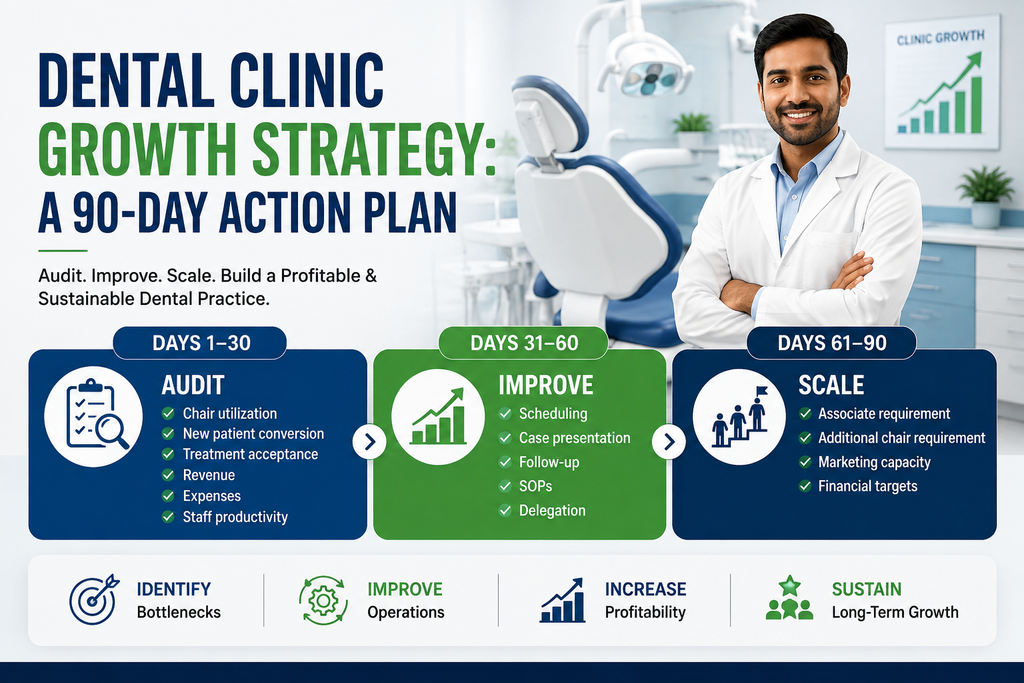
Days 1–30: Audit Your Dental Practice
Before making major investments, establish your current baseline.
- Measure dental chair utilization rate: Calculate how much of your available clinical chair time is actually being used.
- Track new patient conversion: Measure how many enquiries or consultations become scheduled appointments.
- Measure treatment acceptance: Track the percentage of recommended treatments that patients accept and schedule.
- Review revenue and expenses: Examine monthly collections, staff costs, laboratory expenses, rent, marketing expenditure and other operating costs.
- Evaluate staff productivity: Identify tasks that can be delegated and areas where workflow improvements are needed.
Days 31–60: Improve Dental Practice Operations
Use the information from your first 30 days to address the biggest bottlenecks.
- Improve appointment scheduling: Reduce gaps, cancellations and unused chair time.
- Improve case presentation: Standardize how treatment options, benefits, costs and next steps are explained to patients.
- Strengthen patient follow-up: Create a consistent system for pending treatments, missed appointments and recall visits.
- Develop SOPs: Document important recurring processes so the clinic can operate consistently.
- Delegate appropriately: Shift suitable administrative and non-clinical responsibilities away from the dentist.
Days 61–90: Prepare to Scale
Once your systems are improving, determine whether your practice is ready for additional capacity.
- Evaluate associate dentist hiring: Consider an associate when patient demand, chair utilization and financial performance support additional clinical capacity.
- Assess additional chair requirements: Determine whether another dental chair is justified by sustained demand rather than occasional busy periods.
- Review marketing capacity: Increase patient acquisition efforts only when the clinic can efficiently handle additional demand.
- Set financial targets: Establish measurable goals for revenue, expenses, profitability, chair utilization and patient retention.
The objective of a 90-day growth plan is not simply to attract more patients. It is to build efficient dental clinic operations, improve profitability and create systems that allow the practice to scale sustainably.
Final Thoughts
The strongest dental clinic growth strategy is not simply “get more patients.” It is building a practice where capacity, people, finances, treatment acceptance, and marketing work together.
Start with your biggest bottleneck. Improve chair utilization, establish financial benchmarks, strengthen case presentation, develop an associate dentist hiring framework, and build predictable patient acquisition.
That is how a dentist can move from a busy solo practice toward a scalable dental enterprise—without relying entirely on the owner’s chair time.
What is the typical net profit margin of a private dental clinic?
There is no single universal number. Profitability depends on rent, staffing, doctor compensation, laboratory costs, treatment mix, marketing, equipment costs, and collections. Use your own historical financial data alongside appropriate benchmarks.
How do I know if my clinic needs marketing or operational restructuring?
If your chairs are empty, patient acquisition may be the priority. If chairs are consistently full but revenue or profitability is disappointing, operational restructuring may be more important.
When should a dentist invest in a second dental chair?
Consider it when existing chair capacity is consistently high, patient demand is sustainable, staffing is available, and the additional chair has a realistic path to generating profitable production.
How can I increase case acceptance without sounding pushy?
Focus on diagnosis, education, transparency, and patient choice. Explain the clinical problem, treatment alternatives, consequences of delaying appropriate care, expected outcomes, timeline, and fees. The goal should be informed decision-making—not pressure.
Last Updated on August 24, 2026 by Dr. Anuran Ghosh Mondal

Dr. Anuran Ghosh Mondal is a BDS-qualified dentist, private practitioner and dental clinic owner with 12+ years of clinical experience in India. He is the founder of DentalClinicAlly.com and DentistUpgrade.com and has practical experience in Dental Clinic Business Consulting- dental practice management, patient acquisition, market analysis, branding, marketing and clinic growth.