
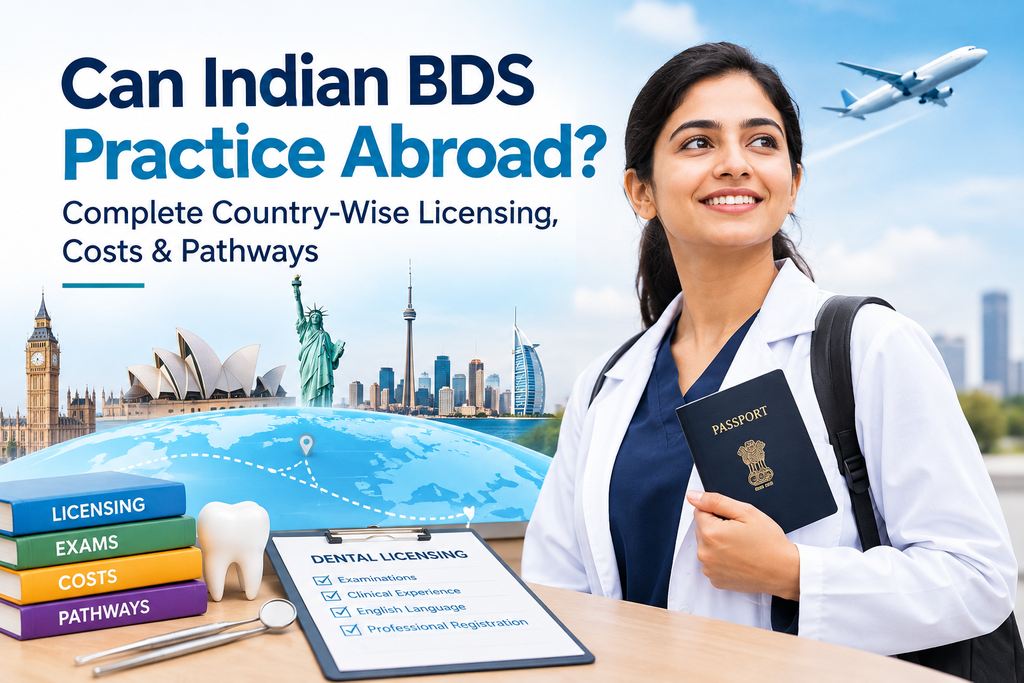
Can Indian BDS practice abroad? Yes, an Indian BDS graduate can become a practising dentist in several countries, but an Indian BDS degree usually does not provide automatic permission to practise dentistry overseas. Most countries require an overseas dentist to complete a licensing, assessment or equivalency process before clinical practice. Depending on the country, you may need to pass examinations, complete additional dental education, demonstrate clinical experience, meet English-language requirements and obtain professional registration.
If you are still deciding what to do after BDS, you can also read our guide to Career Options After BDS: Courses, Jobs & Career Pathways.
Important: Dental licensing, examination fees, immigration rules and eligibility requirements can change. Always verify the latest requirements with the official regulator before making financial or career decisions.
The Short Answer: Can You Practice Dentistry Abroad Directly with an Indian BDS?
An Indian BDS is a professional dental qualification, but it is not automatically equivalent to a local dental licence in countries such as the UK, Australia, USA or Canada.
There are two broad pathways:
1. Direct Licensing / Examination Routes: You retain your Indian BDS and demonstrate that your knowledge and clinical skills meet the destination country’s standards. Examples include the UK ORE, Australian ADC pathway and UAE licensing routes.
2. Re-Education / Advanced Standing Routes: You complete additional dental education before becoming eligible for registration. This is particularly important in the USA, while Canada offers both an equivalency examination route and university-based qualifying programs.
Therefore, the important question is not simply “Is Indian BDS valid abroad?” but “Which country offers the most suitable licensing pathway for my qualification, experience, budget and career goals?”
Direct Licensing Exam Routes: Practice Without Repeating Dental School
United Kingdom (GDC Registration via ORE & LDS)
Indian dentists whose qualifications are not recognised for UK registration can pursue the Overseas Registration Examination (ORE) before applying for registration with the General Dental Council (GDC). The GDC also recognises the Licence in Dental Surgery (LDS) route.
ORE Exam Format (Part 1 Theory vs Part 2 Practical)
The ORE has two parts.
- Part 1: Computer-based written examination.
- Part 2: Practical examination assessing clinical skills and professional competence.
ORE Part 1 contains two three-hour papers covering dental science, human disease, clinical dentistry, law, ethics and health and safety. Candidates must pass both papers before progressing to Part 2.
For the latest examination dates and fees, check the General Dental Council – Overseas Registration Examination (ORE).
Eligibility & Clinical Hours Documentation (The 1,600-Hour Rule)
One important requirement for overseas applicants is evidence of at least 1,600 hours of clinical experience involving treating patients in the dental chair. The GDC allows relevant clinical experience to be demonstrated through appropriate references, including evidence from dental education or post-qualification practice.
This makes proper documentation extremely important for Indian BDS graduates.
If you need to build practical experience after graduation, read How to Get Clinical Experience After BDS.
Total Estimated Budget in INR (Exam Fees, Travel & Prep)
The GDC currently lists the ORE Part 1 fee at £485. Part 2 has a substantially higher examination fee, while preparation courses, instruments, travel, accommodation and repeat attempts can significantly increase the overall cost.
For an Indian dentist, a realistic planning budget can therefore reach ₹10–20 lakh or more, depending on preparation and number of attempts.
Australia & New Zealand (ADC Pathway)
Australia is another major destination for internationally qualified dentists. The Australian Dental Council (ADC) pathway involves initial assessment, written examination and practical examination.
ADC Written Examination vs Practical Bench Test
The ADC written examination is a two-day computer-delivered multiple-choice examination. After successfully completing the required stages, candidates progress to the practical examination.
The ADC currently states that a successful written examination pass is valid for five years.
Check the [Australian Dental Council – Internationally Qualified Dentists] for current assessment requirements, fees and examination dates.
English Language Benchmarks (IELTS vs OET for Ahpra)
Dental registration in Australia also requires applicants to satisfy the applicable Ahpra English language standard.
Accepted English-language pathways can include IELTS Academic and OET, among other recognised tests. Requirements are specified by test component, so candidates should check the current standard rather than relying on old coaching or agent information.
See the official Ahpra – English Language Skills Registration Standard before booking your test.
Visa Pathways and Regional Sponsorship for Indian Dentists
Passing the ADC examinations does not automatically provide Australian permanent residency or a work visa.
Immigration is a separate process involving factors such as occupation eligibility, skills assessment, English proficiency, employer sponsorship and the requirements of the relevant visa category.
Regional opportunities may provide additional migration pathways depending on current Australian immigration policy.
United Arab Emirates & Gulf Countries (DHA, MOH, DOH)
For experienced Indian dentists looking for overseas employment, the UAE can be an attractive option.
Different authorities operate in different jurisdictions, including DHA in Dubai and DOH in Abu Dhabi. The UAE’s Unified Healthcare Professional Qualification Requirements establish qualification and experience standards for healthcare professionals.
The Mandatory 2-Year Post-Internship Clinical Experience Rule
Experience requirements depend on the professional title and regulator. For example, UAE requirements for General Dentist roles include recognised dental qualifications and relevant post-internship professional experience under the applicable requirements.
Therefore, Indian dentists should carefully verify the current Professional Qualification Requirements before applying.
Prometric Exam Pattern & Primary Source Dataflow Verification
Depending on the regulator and application category, dentists may need an assessment or computer-based licensing examination as well as verification of qualifications and professional documents.
The UAE process can involve verification of education, professional registration, experience and good-standing documentation.
For Dubai, check the official Dubai Health Authority (DHA). For Abu Dhabi, check the Department of Health – Abu Dhabi (DOH).
Typical Dentist Salaries in Dubai & Abu Dhabi
Dentist salaries in the UAE vary significantly according to experience, clinic, speciality, commission structure and patient-generation responsibilities.
Do not select the UAE only because an advertised salary appears high. Compare the complete financial picture, including accommodation, transport, licensing expenses, insurance and other living costs.
Re-Education / Advanced Standing Routes (Where You May Need Additional Dental Education)
United States of America (INBDE + Advanced Standing DDS/DMD)
The USA is generally a more expensive and academically demanding route for an Indian BDS graduate.
US dental licensure requirements are determined by individual state dental boards. International dentists commonly pursue advanced standing DDS/DMD programs because many states require a dental degree from a CODA-accredited program.
Passing the Integrated National Board Dental Exam (INBDE)
The Integrated National Board Dental Examination (INBDE) is a major examination for international dentists pursuing US dental education and licensure pathways.
The INBDE is a two-day examination and is accepted by US jurisdictions as fulfilling all or part of the written examination requirement, subject to individual state rules.
See the official JCNDE – INBDE for current examination information.
CAAPID Application & Bench Test Preparation
International dentists can apply to participating advanced-standing dental programs through CAAPID, administered by ADEA.
Individual dental schools may require additional components such as English testing, interviews, practical/bench assessments and other application requirements.
Financial Reality Check: Managing the ₹1.5 Cr–₹2.5 Cr Tuition Burden
The US pathway can require a very substantial financial commitment.
Depending on the university, tuition, living expenses, health insurance, equipment, fees and other costs, an international dentist may need a financial plan reaching approximately ₹1.5–₹2.5 crore or more.
Therefore, calculate the expected total cost and return on investment, rather than looking only at the eventual dentist salary.
Canada (NDEB Equivalency vs Qualifying Programs)
Canada provides internationally educated dentists with more than one pathway.
The Direct NDEB Equivalency Process (AFK, ACJ, NDECC)
The NDEB Equivalency Process includes:
- Assessment of Fundamental Knowledge (AFK)
- Assessment of Clinical Judgement (ACJ)
- NDECC
Successful completion allows candidates to move to the NDEB Certification Process.
Current NDEB fees include CAD 1,000 for AFK, CAD 1,350 for ACJ and CAD 6,500 for NDECC, although fees can change.
See the official [NDEB – Equivalency Process] and [NDEB – Examination Fees] for current information.
Canadian University 2-Year International Dentist Programs (IDP)
Instead of completing the entire equivalency route, eligible international graduates can apply to accredited Qualifying/Degree Completion Programs offered by Canadian dental faculties.
These programs are designed to familiarise international graduates with Canadian dentistry and can lead to eligibility for the NDEB Certification Process.
Comprehensive Comparison: Exam, Timeline, and Total Cost in INR
| Country | Main Route | Repeat Dental School? | Approx. Timeline* | Approx. Cost* |
|---|---|---|---|---|
| 🇬🇧 UK | ORE / LDS | No | 1.5–4+ years | ₹10–20+ lakh |
| 🇦🇺 Australia | ADC | No | 2–4+ years | ₹15–30+ lakh |
| 🇦🇪 UAE | DHA/DOH/MOH routes | Usually no | 3–12+ months | ₹1–4+ lakh+ |
| 🇺🇸 USA | INBDE + DDS/DMD | Yes | 3–5+ years | ₹1.5–2.5+ crore |
| 🇨🇦 Canada | NDEB / Qualifying Program | Route dependent | 2–5+ years | ₹15 lakh–₹1 crore+ |
*These are planning estimates, not official quotations. Actual costs depend on examination attempts, preparation, tuition, travel, accommodation, exchange rates and immigration expenses.
Documents Indian Dentists Should Prepare Before Applying Abroad
Before beginning an overseas dental licensing process, organise:
- BDS degree certificate
- Internship completion certificate
- Academic transcripts
- Dental Council registration
- Certificate of good standing
- Clinical experience letters
- Passport
- Professional references
- English-language test results, where required
- Name-change or identity documents, where applicable
Requirements differ by country, so always check the relevant regulator before submitting documents.
Non-Clinical Master’s Alternatives: Moving Abroad Without Licensing Exams
Not every Indian BDS graduate wants to continue clinical dentistry abroad.
Master of Public Health (MPH) & Health Informatics
An MPH, Health Informatics, Epidemiology or Global Health qualification can provide an alternative route into healthcare without obtaining a foreign dental licence for non-clinical roles.
Possible career areas include:
- Public health
- Healthcare data
- Health technology
- Epidemiology
- Research
- Healthcare consulting
Healthcare Administration (MHA) & Dental Research Fellowships
Other alternatives include Healthcare Administration, Healthcare Management, clinical research, dental research and healthcare quality roles.
These pathways may suit BDS graduates who want an international healthcare career but do not want to repeat dental education or obtain a clinical dental licence.
5 Critical Mistakes Indian Dentists Make When Planning to Go Abroad
Underestimating the Practical Exam Manikin Costs
Practical examinations can require expensive equipment, instruments, materials, typodonts/manikins and preparation.
Do not budget only for the examination fee.
Relying on Outdated Study-Abroad Agents Selling Unlicensed Programs
Dental licensing is controlled by professional regulators and government authorities—not private agents.
Always verify the pathway directly with the relevant regulator.
Failing to Keep State Dental Council Registrations Active During the Move
Maintain your Indian registration and keep your degree, internship, transcripts, good-standing documents and experience certificates organised.
Choosing a Country Only Because the Salary Looks High
Compare:
Salary → Tax → Rent → Insurance → Licensing costs → Living expenses → Education debt → Savings
The highest advertised salary may not provide the highest savings.
Assuming a Licence Automatically Means You Can Open Your Own Clinic
Professional registration, employment rights and clinic/business licensing can be separate requirements.
Always check the rules for employment, scope of practice, ownership and facility licensing.
Planning to Grow Your Dental Practice?
Moving abroad is not the only career-growth option for an Indian dentist. If your goal is to build a stronger private dental practice in India, DentalClinicAlly provides dentist-focused Dental Clinic Growth Services covering areas such as professional branding, online visibility and clinic-growth strategy.
Explore Dental Clinic Growth Services if you are looking for a structured approach to growing your dental practice.
Final Takeaway: Which Country Is Best for an Indian BDS?
There is no single best country for every Indian dentist.
If your priority is avoiding another full dental degree, investigate the UK, Australia and UAE/Gulf licensing routes.
If your goal is long-term settlement and a developed dental market, Australia or Canada may be worth considering, but licensing can be demanding.
If you have the financial resources and want a US dental career, the advanced-standing DDS/DMD route can provide a pathway, but the investment can be substantial.
If you prefer healthcare rather than clinical dentistry, an MPH, Health Informatics, Healthcare Administration or research pathway may be more appropriate.
For every destination, follow this process:
Check the regulator → confirm eligibility → prepare documents → calculate total cost → understand the licensing examination → check immigration options → then make your decision.
Do not choose a country based only on an agent’s promise of “easy licensing” or a high advertised salary.
Launching a new clinic?
Prevent expensive layout, vendor, and lease errors before spending your capital. Get doctor-led practice planning with an independent Dental Clinic Setup Consultant in India.
Frequently Asked Questions: Practicing Abroad After BDS
Is NEET MDS required to practice dentistry abroad?
No. NEET MDS is not a universal requirement for overseas dental licensing. An Indian BDS graduate can pursue the licensing pathway specified by the destination country.
However, postgraduate qualifications may improve career opportunities in some countries. They do not automatically replace the destination country’s licensing requirements.
Can an Indian BDS open a clinic directly in Dubai?
Not simply on the basis of an Indian BDS degree. You must first meet the applicable professional licensing requirements, and clinic ownership/facility licensing can be a separate matter.
UAE regulators assess qualifications, experience and other requirements under the applicable professional qualification framework.
How long is an ADC or ORE pass certificate valid?
For Australia, the ADC currently states that a successful written examination pass is valid for five years. The ADC practical examination follows the written examination in the assessment pathway.
For the UK, candidates should check the GDC’s current ORE rules concerning progression, examination attempts and registration.
Can Indian BDS dentists get jobs abroad without passing a licensing exam?
Usually, an Indian BDS graduate cannot work as a licensed clinical dentist without satisfying the destination country’s registration requirements.
However, non-clinical healthcare, research, administration, health-technology and public-health roles may not require a dental licence. Always distinguish between working as a dentist and working in the healthcare sector.
Which country is easiest for an Indian BDS dentist to work in?
There is no universally easiest country.
The right choice depends on your clinical experience, English proficiency, budget, examination ability, immigration goals and long-term career plans.
The UAE may be attractive to experienced dentists seeking overseas employment, while the UK and Australia offer established assessment pathways. Canada and the USA can involve substantial examinations and/or additional dental education.
Last Updated on October 8, 2026 by Dr. Anuran Ghosh Mondal

Dr. Anuran Ghosh Mondal is a BDS-qualified dentist, private practitioner and dental clinic owner with 12+ years of clinical experience in India. He is the founder of DentalClinicAlly.com and DentistUpgrade.com and has practical experience in Dental Clinic Business Consulting- dental practice management, patient acquisition, market analysis, branding, marketing and clinic growth.