
Knowing how to present dental treatment plan recommendations effectively is an important communication skill for dentists. A correct diagnosis alone may not lead to treatment acceptance if patients do not clearly understand their dental problem, why treatment is necessary, or what options are available.
A well-presented treatment plan is not a sales pitch. It is a clear and patient-focused discussion that helps patients understand their condition and make an informed decision.
Why Most Dental Case Presentations Fail in Indian Clinics
Many patients postpone dental treatment because they leave the clinic with unanswered questions.
They may wonder:
- Do I really need this treatment?
- Can I manage the problem with medicines?
- Can the treatment wait?
- Why does it cost so much?
- Is there a cheaper option?
- Should I discuss this with my family?
A good dental consultation should answer these questions before the patient leaves the clinic.
The “Ghar Pe Baat Karke Batata Hoon” Dilemma
Most Indian dentists have heard:
“Doctor, ghar pe baat karke batata hoon.”
Sometimes the patient genuinely needs to discuss the treatment with family members. However, it may also indicate that the patient is confused about the diagnosis, treatment, cost, or urgency.
Instead of pressuring the patient, focus on explaining:
Dental Problem → Why Treatment Is Needed → Recommended Solution → Options → Cost → Next Step
3 Fatal Mistakes Dentists Make During Consultations
| Common Mistake | Why It Fails | Better Approach |
|---|---|---|
| Leading with cost | The patient focuses only on price | Explain diagnosis first |
| Using clinical jargon | The patient becomes confused | Use simple language |
| Giving one large estimate | The treatment feels overwhelming | Present treatment in phases |
Mistake 1: Leading with Cost Instead of Diagnosis
If the first thing a patient hears is, “This treatment will cost ₹30,000,” the discussion immediately becomes about price.
First explain the problem and the reason for treatment. Then discuss the treatment options and cost.
Mistake 2: Drowning the Patient in Clinical Jargon
Clinical terminology may be accurate but difficult for patients to understand.
Instead of saying:
“You have severe periapical pathology,”
you can explain:
“There is an infection around the root of your tooth, which may be causing the pain and swelling.”
Mistake 3: Overwhelming Patients with a Lump-Sum Plan
Complex cases may involve several procedures. Presenting everything at once can overwhelm patients.
Whenever clinically appropriate, explain the treatment in a logical sequence or phases.
The 9-Step Framework for Presenting Dental Treatment Plans
Following a structured process can help dentists present dental treatment plan recommendations consistently.
The 9-Step Framework for Presenting Dental Treatment Plans
A simple, patient-centered approach dentists can use to explain treatment clearly.
Listen to the Patient
Understand the patient’s main concern, expectations, fears, and treatment goals before discussing the treatment plan.
Explain the Diagnosis
Explain the dental problem in simple, understandable language. Avoid unnecessary technical terminology.
Show the Clinical Findings
Use intraoral photographs, X-rays, scans, models, or other appropriate visual aids to help patients understand their condition.
Present the Treatment Options
Explain the clinically appropriate treatment options, including their benefits, limitations, and expected outcomes.
Explain the Benefits and Risks
Discuss what the recommended treatment can achieve, along with relevant risks, limitations, and possible alternatives.
Discuss the Treatment Timeline
Explain the expected number of appointments, treatment duration, healing period, and important follow-up requirements.
Discuss the Cost Clearly
Explain the estimated treatment cost and any relevant payment or financial considerations in a transparent manner.
Answer Questions and Address Concerns
Give patients enough time to ask questions and discuss concerns about pain, treatment, cost, time, or outcomes.
Agree on the Next Step
Confirm that the patient understands the proposed plan and discuss the appropriate next step, such as scheduling treatment or reviewing the options later.
Step 1: Listen to the Patient First
Before discussing treatment, listen carefully to the patient.
Ask questions such as:
- What problem brought you here today?
- When did the problem start?
- Are you experiencing pain while eating?
- Has the condition become worse recently?
Avoid interrupting the patient too quickly.
Listening helps you understand the patient’s experience and creates trust before discussing treatment.
Step 2: Understand the Patient’s Main Concern
The clinical diagnosis may not always be the patient’s main concern.
For example, a patient may have multiple dental problems but may primarily be concerned about:
- Pain
- Difficulty chewing
- A broken front tooth
- Appearance
- Bad breath
- Fear of losing a tooth
Ask:
“What concerns you the most about this problem?”
Once you understand the patient’s priority, you can explain how the recommended treatment relates to that concern.
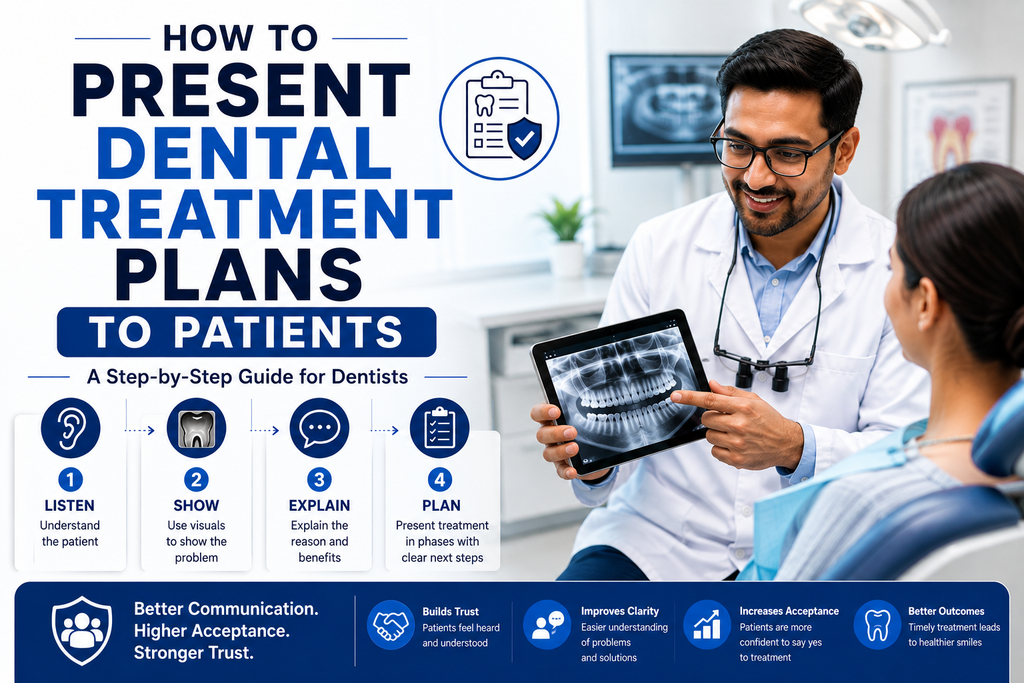
Step 3: Explain the Dental Problem Clearly
After examining the patient, explain the problem in simple language.
A useful structure is:
What is the problem → What caused it → What may happen if it progresses
For example:
“This tooth has a deep cavity. The decay has reached the inner portion of the tooth, which is causing pain. If the infection progresses, saving the tooth may become more difficult.”
Before discussing treatment, make sure the patient understands the problem.
Step 4: Show X-rays, Intraoral Photos or Visual Aids
Patients often understand their dental condition better when they can see it.
Use appropriate visual aids such as:
- RVG or digital X-rays
- Intraoral photographs
- Intraoral cameras
- Study models
- Dental diagrams
The principle is:
Show → Explain → Recommend
For example, instead of simply saying that there is bone loss, show the patient the relevant X-ray and explain the problem.
Using Visual Aids for Complex Treatments
For treatments such as dental implants, aligners, and full-mouth rehabilitation, study models or digital presentations may help patients understand the treatment process.
Visual aids should improve understanding, not create unrealistic expectations.
Step 5: Explain Why Treatment Is Necessary
Patients should understand why you are recommending a particular treatment.
Use this structure:
Problem → Treatment → Expected Benefit → Possible Consequences of Delay
For example:
“The infection inside your tooth is causing the pain. Root canal treatment may help remove the infection and preserve the tooth if it is restorable. If treatment is delayed, the infection may progress further.”
Avoid fear-based communication.
The goal is informed decision-making.
Step 6: Present the Recommended Treatment Plan
Now explain the recommended treatment.
For complex cases, divide the treatment into phases whenever clinically appropriate.
Present the Recommended Treatment Plan
Organize treatment into clear phases so patients can understand what needs to be done, why it is needed, and what to expect.
| Treatment Phase | Main Objective | Examples |
|---|---|---|
|
Phase 1
Disease Control & Urgent Care
|
Address pain, infection, active disease, trauma, or other urgent problems that require priority treatment. |
Examples:
Emergency pain relief, treatment of dental infection, extraction of a non-restorable tooth, temporary restoration, or management of acute dental problems. |
|
Phase 2
Definitive Treatment
|
Complete the necessary restorative, periodontal, endodontic, surgical, or other definitive treatment to restore oral health and function. |
Examples:
Root canal treatment, crowns, fillings, periodontal therapy, replacement of missing teeth, or other clinically appropriate definitive treatments. |
|
Phase 3
Rehabilitation, Maintenance & Prevention
|
Maintain treatment results, restore long-term function and aesthetics where appropriate, and reduce the risk of future dental problems. |
Examples:
Prosthetic or cosmetic rehabilitation when indicated, orthodontic treatment when appropriate, regular recalls, professional cleaning, oral hygiene education, and preventive care. |
Phase 1: Disease Control & Urgent Care
This may include:
- Emergency treatment
- Infection management
- Root canal treatment
- Extraction of non-restorable teeth
Phase 2: Definitive Treatment
Depending on clinical needs, treatment may include:
- Crowns
- Bridges
- Dental implants
- Dentures
- Periodontal treatment
Phase 3: Rehabilitation, Maintenance & Prevention
The final phase may include:
- Cosmetic dentistry
- Aligners
- Teeth whitening
- Professional cleaning
- Regular recall visits
Breaking treatment into phases can make complex plans easier for patients to understand.
For additional strategies to improve patient decision-making, read our complete guide on How to Increase Dental Treatment Acceptance
Step 7: Discuss Treatment Options and Cost Transparently
Once the patient understands the diagnosis and recommended treatment, discuss the available options and cost.
Patients should understand:
- Recommended treatment
- Alternative options, where clinically appropriate
- Benefits and limitations
- Estimated number of visits
- Approximate treatment cost
Present the Diagnosis Before the Estimate
Follow this sequence:
Diagnosis → Problem → Recommended Treatment → Options → Cost
This gives patients the necessary clinical context before discussing the financial aspect. If patient has financial issues then you can offer him EMI options for Dental treatment.
Handling “Other Clinics Charge Less”
Avoid becoming defensive.
You can explain:
“I understand that cost is an important consideration. Different clinics may recommend different treatment approaches, materials, and clinical protocols. You can compare the treatment recommendations and ask questions before making your decision.”
Focus on clear communication rather than competing only on price.
Step 8: Give the Patient Time to Ask Questions
A treatment presentation should be a conversation.
Ask:
- Do you have any questions?
- Is there anything you would like me to explain again?
- Is any part of the treatment plan unclear?
Patients may have concerns about:
- Pain
- Cost
- Treatment duration
- Number of visits
- Long-term results
Encourage questions and answer honestly.
Step 9: Explain the Next Step Clearly
Do not simply end the consultation by saying:
“Think about it and let me know.”
The patient should understand what happens next.
Possible next steps include:
- Scheduling treatment
- Taking additional diagnostic records
- Beginning Phase 1 treatment
- Reviewing the treatment plan with family
- Returning for a detailed consultation
Clear next steps reduce uncertainty.
The 48-Hour Protocol: Managing Indecisive Patients and Family Consultations
Some patients need time to discuss treatment with family members.
Instead of repeatedly pressuring them, provide helpful information and a structured follow-up process.
Provide a Simple Treatment Summary
Give patients a clear summary containing:
- Diagnosis
- Recommended treatment
- Treatment phases
- Alternative options, where appropriate
- Estimated cost
- Approximate visits
The document should be easy for family members to understand.
Replace Repeated Calls with Automated Follow-Up
A structured communication system can help with:
- Treatment estimate follow-ups
- Appointment reminders
- Recall visits
- Post-treatment instructions
For clinics looking to improve follow-up communication, WhatsApp Automation for Dental Clinics can help streamline patient reminders and communication workflows:
Operatory vs. Consultation Room: Where Should You Present the Plan?
| Type of Case | Suitable Location |
|---|---|
| Filling or simple restoration | Dental operatory |
| Scaling and preventive care | Dental operatory |
| Single-tooth treatment | Dental operatory |
| Multiple implants | Consultation room |
| Full-mouth rehabilitation | Consultation room |
| Complex cosmetic treatment | Consultation room |
Operatory for Minor Cases
Simple treatments can usually be explained chairside using X-rays or intraoral photographs.
Consultation Room for Complex Cases
For high-value or complex treatments, a private consultation space may provide enough time for detailed discussion without affecting clinical workflow.
Scaling Chairside Case Acceptance into Predictable Clinic Growth
Learning how to present dental treatment plan recommendations effectively can improve more than treatment acceptance.
It can also improve:
- Patient trust
- Communication
- Follow-up consistency
- Treatment completion
- Long-term patient retention
Measure Your Treatment Acceptance Rate
Use this formula:
Treatment Acceptance Rate = Accepted Treatment Plans ÷ Treatment Plans Presented × 100
Tracking this number regularly can help identify areas that need improvement.
For example:
- Are patients unclear about the diagnosis?
- Is cost discussed too early?
- Are treatment plans too complicated?
- Are follow-ups consistent?
Want to Keep This Checklist?
Download the free printable Dental Treatment Plan Presentation: Self-Assessment & Improvement Checklist and use it to review your treatment-plan presentation process.
Turning Emergency Patients into Long-Term Patients
Emergency treatment should be the beginning of a patient relationship, not necessarily the end.
After managing pain or infection, discuss:
- Completion of recommended treatment.
- Restoration of oral function.
- Preventive dental care.
- Regular recall visits.
To build stronger systems and scale your practice beyond chairside treatment discussions, explore the Dental Clinic Growth framework:
My Suggestions as a Dentist:
As a dentist, my suggestion is simple: focus on helping patients understand before expecting them to decide.
When you present dental treatment plan recommendations, listen carefully to the patient, understand their main concern, explain the dental problem in simple language, and use X-rays or visual aids whenever possible. Explain why treatment is necessary before discussing the treatment cost.
Most importantly, do not treat the consultation as a sales pitch. Give patients clear information, answer their questions honestly, and explain the next step properly.
In my experience, better communication builds patient trust, and trust plays an important role in treatment acceptance and long-term patient relationships.
Frequently Asked Questions:
When should a dentist introduce the treatment plan cost?
Discuss the cost after explaining the diagnosis, recommended treatment, and available options.
How long should an ideal dental case presentation take?
Simple cases may take a few minutes, while complex cases may require a separate consultation of approximately 20–45 minutes.
What is the ideal treatment plan acceptance rate for a private clinic?
There is no universal ideal rate. Acceptance varies according to treatment type, patient demographics, and case complexity. Track your clinic’s own performance and focus on improvement.
How do I handle patients who only want emergency pain relief and refuse crowns?
Respect their decision, explain the recommended long-term treatment and possible consequences of delaying it, and provide appropriate follow-up recommendations without pressure.
Last Updated on September 12, 2026 by Dr. Anuran Ghosh Mondal

Dr. Anuran Ghosh Mondal is a BDS-qualified dentist, private practitioner and dental clinic owner with 12+ years of clinical experience in India. He is the founder of DentalClinicAlly.com and DentistUpgrade.com and has practical experience in Dental Clinic Business Consulting- dental practice management, patient acquisition, market analysis, branding, marketing and clinic growth.